As part of the CogniQuest project, implemented within the Erasmus+ programme, we created 10 adventure storybooks for children, each designed to develop metacognitive skills such as planning, critical thinking, self-regulation, and perseverance. Every story was crafted to be not only engaging, but also a practical tool for teaching effective learning strategies.
Today, we invite you to explore the potential of one of these books – The wings of Icarus.
“The wings of Icarus” – a story about the art of learning
The main character, Theo, lives in a small village and has one big dream: to fly. Although others think he is strange, he does not give up. One day he discovers an old chest in a cave containing a pair of giant wings – the kind Daedalus is said to have made in the myth. This marks the beginning of his great adventure… and of a long process of learning.
Theo:
- tried and failed,
- observed birds,
- adjusted his strategies,
- and eventually managed to lift off the ground.
Along the way, he meets two mythological birds, Skia and Ether, who teach him to anticipate difficulties and think strategically. And when he sets off on a journey to Helios’ palace, he learns the hard way that a lack of planning can result in… melting wax.
In the end, Theo discovers something more important than flying itself: dreams come true through thinking, planning, acting, reflecting, and learning from every step.
This is exactly the learning cycle at the heart of the story:
dream → goal → planning → action → monitoring → …
How to learn strategically: Theo’s strategy
Theo’s journey provides an excellent opportunity to talk with students about:
- how we learn,
- how to plan our actions,
- how to deal with difficulties,
- how to build independence and resilience in learning.
The key strategies Theo develops include:
- Plan – define your goal and the small steps leading to it.
- Anticipate – think about what might go wrong.
- Observe – check what works and what needs improvement.
- Reflect – learn from both mistakes and successes.
- Ask for help – draw on the knowledge of others.
- Persevere – small progress is still progress.
Activity: “My wings of dreams – My wings of learning”
This activity is a tool for activating metacognitive thinking at the planning stage. It is a short, 10-minute task that works perfectly during homeroom lessons, library activities, tutoring sessions, or individual work.
Metacognitive goal
Developing planning skills and the ability to anticipate difficulties. Students learn to break down a big goal into small, manageable steps.
1. Introduction
Read or briefly summarise Theo’s story. Emphasise that although he had a big dream, he only made real progress once he learned how to plan and monitor his actions. This is the essence of metacognition: before I start acting, I need to think about how I will do it.
2. Task
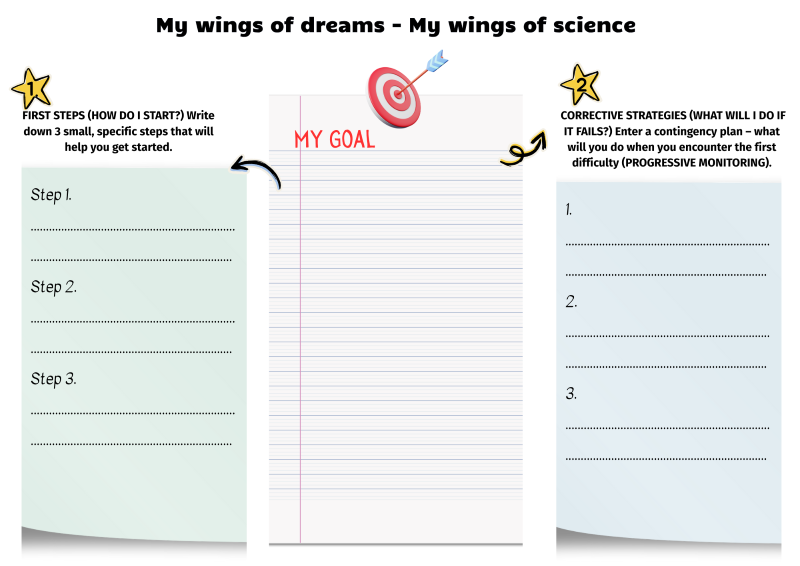
Hand out worksheets or blank sheets of paper, or display the template on the board. Ask students to:
- Write or draw one concrete goal in the centre of the page – a skill they want to learn (e.g., memorising a poem, practising multiplication facts, learning to play the guitar, mastering new English vocabulary, learning to roller skate).
- On the left side, list the small steps that will help them reach this goal.
- On the right side, write a backup plan:
What will I do when I encounter a difficulty?
What strategies can help me keep going?
Why use this activity?
The wings of Icarus is not just a story about dreams. It is an adventure that introduces children to the world of learning strategies in a fun and accessible way. It helps us:
- activate metacognitive thinking,
- strengthen students’ belief in their abilities,
- build independence,
- show that mistakes are a natural part of the learning process.
And this is only one of the ten storybooks created in the CogniQuest project!